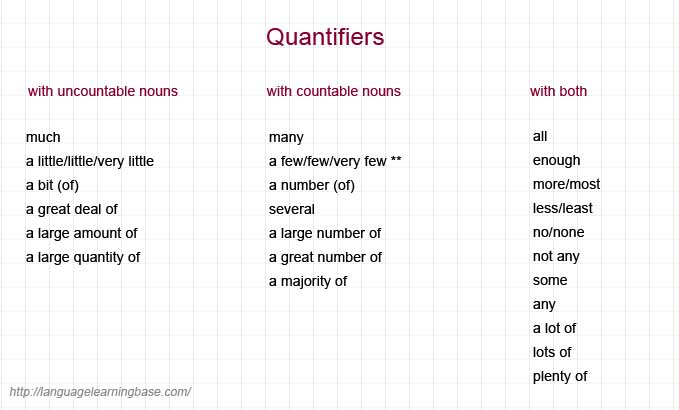
QUANTIFIERS
the quantifiers indicate a name. They are responses to the question "How many?". Like articles, quantifiers define a name and are always located in front of the name. Some may be used only with count nouns, others only names and countless others, both.
We use quantifiers to express the idea of quantity or number. In the following overview you will learn how and when to use them.
look at the following video:
Cuantificador
|
Contable
|
Incontable
|
|
Many |
X
| |
|
Much | |
X
|
|
Some |
X
|
X
|
|
Any |
X
|
X
|
|
No, none |
X
|
X
|
|
A lot of/Lots of |
X
|
X
|
|
Little/A little | |
X
|
|
Few/A few |
X
| |
*Many
Meaning: Many
Use: It expresses the idea of wealth. It is used mainly in negative and interrogative with plural count noun phrases. You can use "many" in affirmative sentences, although not very common. Normally, we use other quantifiers like "a lot."
*Much
Meaning: Many
Use: As "many" expresses the idea of wealth and is used mainly in negative and interrogative sentences. The difference with "many" is that we use "much" only uncountable nouns singular. You can use "much" in affirmative sentences, though it would be more formal and not so common.
*Some
Meaning: Some, some
Usage: Use with both names or singular countable nouns as names or plural countable nouns. It is used in affirmative and interrogative sentences (to say something); "any" is substituted in negative or interrogative sentences. It means an indefinite quantity, but limited.
*Any
Meaning: Some, none
Use: Used in the same context that "some," but in negative or interrogative sentences.
*A lot of / Lots of
Meaning: Many
Usage: lot express idea. It can be used with names or countable and uncountable nouns. Unlike "many" and "much", not use them in interrogative sentences. In general, "lots of" is more
informal.
*Little / A Little
Meaning: Little / s
Use: Express a small amount and are only used for uncountable nouns. The option to use "little" or "a little" reflects an opinion on the amount. If you use "a little" means a positive opinion on the amount and if you use "little" implies a negative opinion.